
Information and Communication Technology (ICT) has evolved far beyond basic computer systems and internet infrastructure. In today’s hyper-connected landscape, ICT acts as the unified backbone combining telecommunications, enterprise software, middleware, storage, and audio-visual systems. It allows users to access, store, transmit, and manipulate information seamlessly across a borderless digital ecosystem.
From powering artificial intelligence (AI) engines to securing multi-cloud environments, modern ICT infrastructure is the single most critical driver of the global digital economy.
Core Pillars of Modern ICT Infrastructure
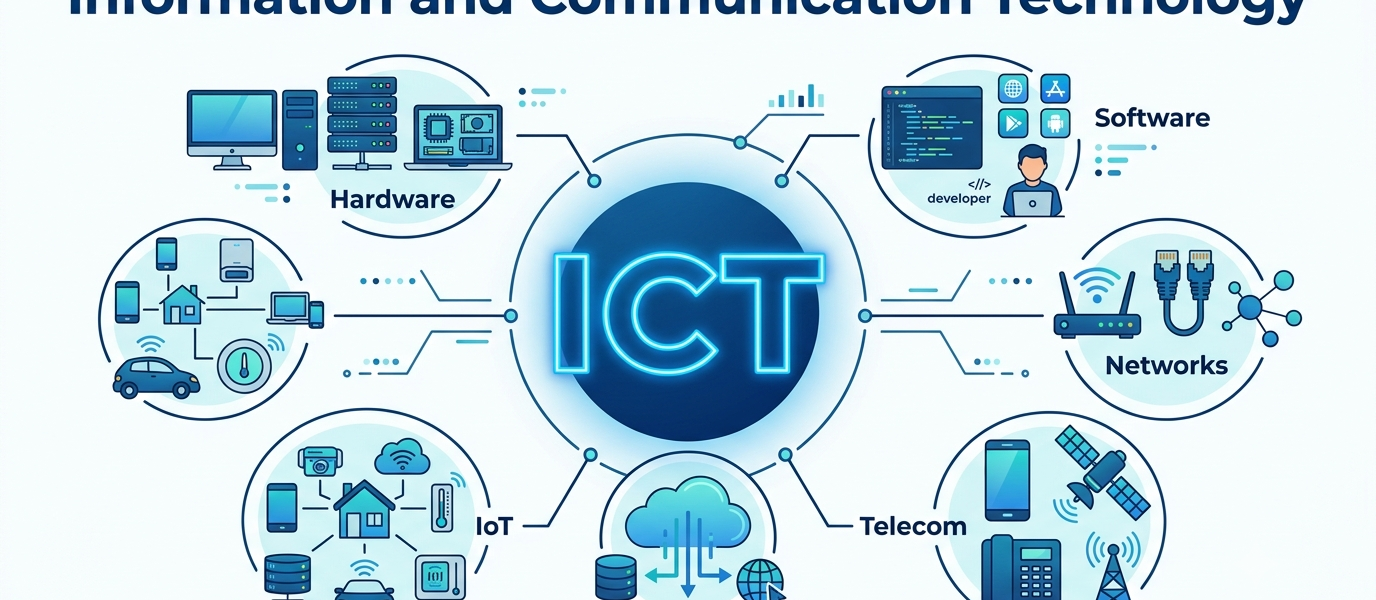
A robust ICT ecosystem relies on several deeply integrated components working in tandem to process millions of operations every second:
┌────────────────────────────────────────┐
│ The ICT Framework │
└───────────────────┬────────────────────┘
│
┌──────────────────────────────┼──────────────────────────────┐
▼ ▼ ▼
[ Hardware ] [ Software ] [ Networks ]
– Edge Devices – ERP & SaaS – 5G / 6G Systems
– Cloud Servers – DBMS Systems – Fiber Optic Links
– IoT Sensors – AI Model Frameworks – Satellite / Starlink
Cloud & Computational Hardware
The physical layer has shifted from localized, on-premise servers to hyper-scale data centers. This includes high-performance edge computing devices, enterprise servers, smart sensors, and advanced semiconductor chips that drive machine learning models.
Communication and Networking Channels
This pillar covers the medium through which data travels. It includes ultra-fast 5G and emerging 6G cellular networks, fiber-optic grids, Wi-Fi 7 standards, and low-Earth orbit (LEO) satellite communications like Starlink, which bring high-speed internet to remote regions.
Enterprise Software and Data Architecture
Software orchestrates the raw computing power. This spans modern Enterprise Resource Planning (ERP) tools, relational and non-relational Database Management Systems (DBMS), and unified software-as-a-service (SaaS) applications that streamline business execution.
High-Traffic Trends Redefining the ICT Landscape
To understand where the global technology ecosystem is headed, businesses and professionals must track the most disruptive shifts currently taking place:
- Generative AI Integration: Artificial Intelligence is no longer just a standalone app. It is heavily integrated directly into the core ICT fabric, automating network configurations, content moderation, and threat hunting.
- The Rise of Edge Computing: Instead of sending all data back to a central cloud server, edge computing processes data directly on local devices (like autonomous cars or factory robotics). This reduces latency and bandwidth costs.
- Quantum Networking Protocols: As traditional encryption faces threats from quantum computers, ICT research is shifting toward Quantum Key Distribution (QKD) to build hack-proof communication channels.
- Next-Gen Cyber Security (Zero Trust): With remote work and decentralized cloud storage becoming standard, the strict “never trust, always verify” Zero-Trust Architecture has replaced traditional firewalls
- Green ICT and Sustainable Tech: Data centers consume vast amounts of electricity. Industry leaders are pivoting to liquid-cooling setups, carbon-neutral cloud infrastructure, and eco-friendly hardware recycling pipelines to meet ESG guidelines.
The Industrial Impact of Advanced ICT
ICT is the primary force rewriting how traditional industries scale, minimize human error, and generate revenue:
| Target Industry | Core Technological Application | Tangible Business Benefit |
| Healthcare | Telehealth grids, IoT wearable health monitors, AI diagnostic tools | Real-time remote patient monitoring, faster discovery of custom therapeutics |
| Finance (FinTech) | High-frequency trading algorithms, blockchain ledgers, unified API banking | Zero-friction cross-border payments, automated AI fraud detection loops |
| Education (EdTech) | Cloud-based Learning Management Systems (LMS), AR/VR classrooms | Democratized access to immersive, borderless learning modules |
| Manufacturing | Industrial Internet of Things (IIoT), digital twin modeling, smart factory nodes | Predictive maintenance tracking, massive reductions in assembly line downtime |
High-Demand Career Paths in the ICT Domain
The rapid expansion of communication networks has opened up high-paying, future-proof career pathways for certified specialists:
1. Cloud Architect & DevSecOps Engineer
- Role: Designing, migrating, and maintaining multi-cloud spaces (AWS, Azure, Google Cloud) while building automated, secure software deployment pipelines.
- Key Skills: Kubernetes, Docker, Terraform, CI/CD tool tracking, cloud security frameworks.
2. Network Security & Cryptography Specialist
- Role: Protecting critical corporate network infrastructure from sophisticated cyber-threats, zero-day vulnerabilities, and data breaches.
- Key Skills: Pen-testing, ethical hacking, firewall configuration, intrusion detection systems (IDS).
3. IoT Solutions Architect
- Role: Engineering the connectivity blueprints for smart cities, automated grids, and industrial sensor networks.
- Key Skills: Embedded systems, MQTT/CoAP protocols, firmware security, wireless hardware design.
4. Data Engineer & Business Intelligence Analyst
- Role: Building massive data pipelines that gather unstructured network data, cleaning it, and transforming it into real-time visual dashboards for corporate executives.
- Key Skills: SQL, Python, Apache Spark, Snowflake, Tableau, PowerBI.
Final Overview: Embracing the Connected Future
Information and Communication Technology is no longer an auxiliary department in modern corporations—it is the core strategy. As businesses transition deeper into the digital age, mastering ICT networks, data pipelines, and cloud systems will dictate which organizations lead and which fall behind.
Frequently Asked Questions (FAQs)
1. What is the fundamental difference between IT and ICT?
While Information Technology (IT) focuses mainly on managing and processing data inside a specific computer or localized network, Information and Communication Technology (ICT) is a broader term. ICT explicitly highlights the integration of electronic communication channels—such as cell networks, wireless signals, and satellite systems—with traditional computer software and hardware.
2. How is 5G technology changing the face of ICT?
5G networks deliver significantly higher data speeds, ultra-low latency, and massive device capacity. This allows ICT ecosystems to support data-heavy technologies that require instant responses, such as real-time remote surgeries, fully autonomous drone fleets, and immersive virtual reality environments.
3. What does “Zero Trust Architecture” mean in ICT networks?
Zero Trust is a modern security model built on the principle that no user or device should be trusted by default, whether they are inside or outside the organization’s network perimeter. It requires continuous, strict authentication and validation at every stage of a digital interaction.
4. What are the major challenges facing global ICT deployment?
The biggest hurdles include the growing global digital divide between developed and developing nations, escalating cyber warfare threats, electronic waste (e-waste) accumulation, and the massive energy demands required to power modern AI-driven data centers.
5. What certifications are best to launch a career in ICT infrastructure?
For networking and cloud engineering, top-tier industry validations include Cisco Certified Network Associate (CCNA), CompTIA Security+, AWS Certified Solutions Architect, and Google Cloud Professional Cloud Architect.